Cat Food vs Dog Food: What Pet Parents Should Know Before Sharing One Bowl
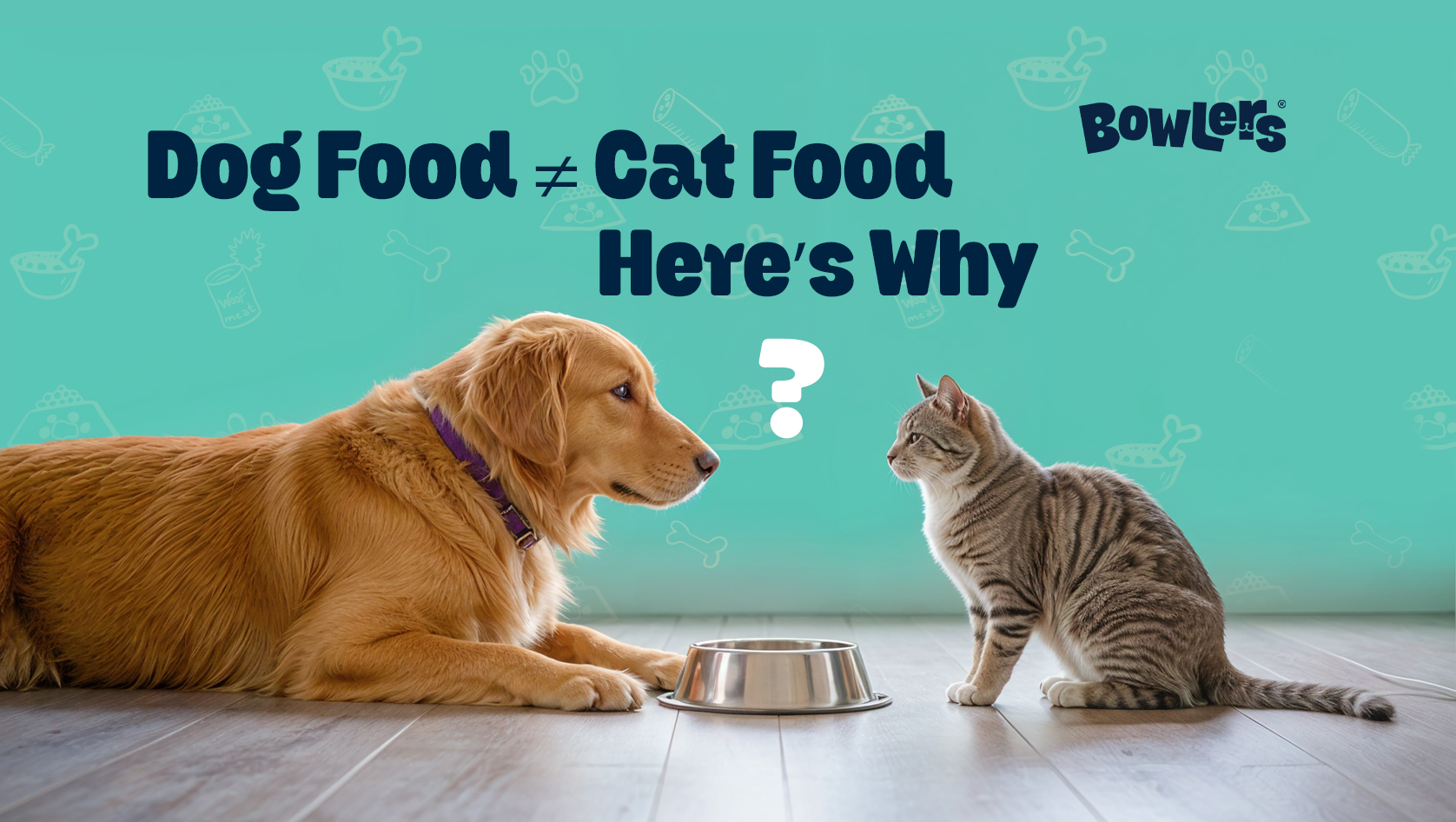
Table of contents
- Why this question is getting louder in India
- The core difference in one sentence
- The numbers, side by side
- The five things cat food has that dog food does not need
- Direction one: your cat eats dog food
- Direction two: your dog eats cat food
- The money question, answered honestly
- The India-specific realities nobody mentions
- How to read an Indian pet food label in 60 seconds
- The multi-pet household playbook
- Emergency: it is late, the shop is shut, and you have run out
- So what should your dog actually be eating?
- When to stop reading and call a vet
- The bottom line
- FAQs
Cat food and dog food are built for two different animals. Cat food is denser in protein and fat, and contains essential nutrients like taurine, preformed vitamin A, and arachidonic acid that cats cannot synthesize internally. Dog food is more moderate and carries more carbohydrate because dogs can. A stolen mouthful either way is not an emergency. Weeks of the wrong bowl is a real health problem, and it goes wrong in different ways for each animal.
Before we go further, something worth saying out loud: Bowlers makes dog food. We do not make cat food. That means we have no product to sell you on the feline side of this comparison, and no reason to shade the truth about it. If you have a cat, this guide will tell you to buy proper cat food from someone else. That is simply the correct answer.
Why this question is getting louder in India
For a long time, “pet parent” in India almost always meant “dog parent.” That is changing quickly.
India’s cat population grew from about 2.4 million in 2020 to roughly 4.5 million in 2025, a rise of about 13.4% every year, which made cats the fastest-growing pet segment in the country. Dogs still dominate at around 85% of the pet population, close to 33.4 million animals. But cat food retail sales grew faster than any other category in the market.
Put those two trends together, and you get a new and very common Indian household: one dog, one cat, one kitchen, one person doing the shopping.
There is a second reason this question comes up. Roughly 90% of Indian pet owners still do not feed packaged food exclusively. Most homes are running some mix of home-cooked food and commercial food. When you are already improvising, “can I just buy one bag for both” feels like a sensible simplification.
It is not. Here is exactly why.
The core difference in one sentence
Cats are obligate carnivores. Dogs are omnivores that lean carnivore.
That is not a slogan. It is a description of biochemistry. Somewhere in their evolution, cats stopped eating plants, and their bodies quietly switched off the machinery for handling them. They gave up the ability to manufacture certain nutrients internally because prey animals were always going to supply them.
Dogs went the other way. They spent thousands of years alongside human settlements eating our leftovers, and their bodies adapted to extract nutrition from grains, vegetables, and starches alongside meat.
So cat food is not “premium dog food.” It is a different product solving a different problem.
The numbers, side by side
These are minimum standards on a dry matter basis, which is how nutrition scientists compare foods fairly regardless of water content.
| Nutrient | Adult cat needs | Adult dog needs |
| Crude protein (minimum) | 26% | 18% |
| Protein for growth (kitten vs puppy) | 30% | 22.5% |
| Crude fat (minimum) | 9% (typical diets run 12%–20%+) | 5.5% (typical diets run 8%–15%) |
| Taurine | Required in the diet | Dogs make their own |
| Vitamin A | Must be preformed, from animal tissue | Can be converted from beta-carotene in plants |
| Arachidonic acid | Required in the diet, around 0.02% | Dogs make their own from linoleic acid |
| Niacin | Must come from the diet | Efficiently synthesized from tryptophan |
| Carbohydrate tolerance | Low | Moderate to high |
Read that first row again. A cat’s minimum protein requirement is higher than what many perfectly good adult dog foods contain in total.
To make this concrete with a real product: Bowlers Nutrimax Club Adult is a grain-free formula at 27% crude protein and 15% crude fat, which is generous for a dog. Feed it to a cat every day, and you are still handing that cat a food with no added taurine, no guaranteed preformed vitamin A, and no arachidonic acid. Good dog food remains dog food.
The five things cat food has that dog food does not need
1. Taurine
Taurine is an amino acid that supports heart muscle function and the retina. Dogs synthesise it from cysteine and methionine. Cats largely cannot, so it has to arrive in the bowl.
A taurine-deficient cat can develop dilated cardiomyopathy, where the heart muscle stretches and weakens, and retinal degeneration, which damages vision permanently. Both develop quietly over months. By the time you notice, damage may already be done.
2. Preformed vitamin A
Dogs take beta-carotene from carrots, pumpkin, and spinach and convert it into vitamin A. Cats lack the enzyme to do this efficiently. They need retinol, the preformed version found in animal liver and organ tissue.
This is why a dog food packed with lovely orange vegetables can still leave a cat deficient. The vitamin is technically present. The cat simply cannot unlock it.
3. Arachidonic acid
An omega-6 fatty acid that supports skin barrier function, inflammatory response, and reproduction. Dogs manufacture it from linoleic acid found in plant oils. Cats cannot, so it must come from animal fat.
4. Niacin
Dogs convert some tryptophan into niacin. Cats burn through tryptophan too fast for that pathway to keep up, so they need dietary niacin directly.
5. Protein as fuel, not just building material
This is the subtle one. A dog’s liver dials protein breakdown up and down depending on how much protein is available. A cat’s liver runs those enzymes at a constant high rate. It cannot dial down.
The practical consequence: a cat on a low-protein diet does not conserve protein. It keeps burning through it and starts breaking down its own muscle to keep going. This is why a cat can lose condition on food that would keep a dog perfectly healthy.
A bonus fact that explains a lot about fussy cats
In 2005, researchers at the Monell Chemical Senses Center found that cats carry a pseudogene copy of the Tas1r2 gene with a 247 base-pair microdeletion, meaning the sweet taste receptor never assembles properly. Cats are not being dramatic when they ignore something sweet. They physically cannot taste it.
Cat food is therefore formulated to hit meat, fat, and umami notes hard. That intense aroma is exactly what makes dogs raid the cat’s bowl.
Direction one: your cat eats dog food
Most articles treat this as one problem. It is actually two, and they carry different risks.
What actually happens: A cat living mainly on dog food is slowly starved of taurine, retinol, arachidonic acid, and adequate protein. Signs of nutritional deficiency can take anywhere from several weeks to months to manifest, depending on the cat and the quantity, though acute digestive upset can occur sooner.
What to watch for:
- Dull, greasy or flaking coat
- Weight and muscle loss, especially over the spine and hips
- Low energy, sleeping more than usual
- Vomiting, diarrhoea or constipation
- Changes in vision, bumping into things, hesitating in dim light
- Rapid breathing or reduced stamina, which can signal heart involvement
How worried to be: A few stolen bites are genuinely fine. Two or three days in an emergency is not ideal but is survivable. Weeks or months is where permanent damage lives. If your cat has been eating mostly dog food for more than a few days, switch back and book a vet visit. Do not wait for symptoms, because taurine-related heart and eye damage announces itself late.
Direction two: your dog eats cat food
This is far more common in Indian homes, because dogs are opportunists and cat food smells incredible.
What actually happens: Cat food is richer in fat and calories than a dog needs. The problems are the mirror image of the ones above. Not deficiency, but excess.
The three real risks:
- Pancreatitis: A high-fat meal is a recognised trigger for inflammation of the pancreas in dogs. It is painful, sometimes life-threatening, and needs urgent veterinary care. Watch for repeated vomiting, a hunched or “praying” posture with the chest down and rear up, a tender belly, and refusal to eat.
- Excessive Fat and Caloric Density: Cat food is significantly higher in fat and calories than dog food. Consistently eating cat food puts dogs at high risk for weight gain and metabolic strain, while high-fat meals can trigger acute pancreatitis.
- Weight gain: The least dramatic and the most likely. Extra calories every day become extra kilos, and canine obesity is linked to joint disease, reduced mobility and inflammatory conditions.
How worried to be: One raid on the cat’s bowl is usually just an inconvenience. Repeated daily access is the thing to fix. And if your dog has eaten a large volume of rich cat food and starts vomiting repeatedly or shows abdominal pain, treat that as urgent rather than waiting it out.
The money question, answered honestly
Let us be direct, because this is the real reason most people search this topic.
Cat food generally costs more per kilogram than dog food. Meat protein is the expensive part of any recipe, and cat food requires more of it plus supplemented taurine. So running one bag for both animals looks like a saving.
It is a false economy, and here is the arithmetic that matters:
The gap between a month of proper cat food and a month of dog food is real but modest. A single consultation, blood panel and treatment course for pancreatitis in a dog, or an echocardiogram and long-term cardiac management for a taurine-deficient cat, costs a large multiple of that saving. Retinal damage cannot be bought back at any price.
There is also a subtler cost. A cat quietly losing muscle on the wrong diet does not present as an emergency. It presents as an ageing cat. Owners often do not connect the two until much later.
If budget is genuinely the constraint, the better move is to buy a value-tier food that is correctly formulated for each species rather than a premium food for the wrong species. Bowlers Nutrimax Adult exists for exactly this reason: complete nutrition for adult dogs at 20% crude protein, 9% fat and 3,380 kcal/kg, in pack sizes from 100g to 20kg so you can buy at whatever scale your month allows. Then spend the cat budget on actual cat food.
The India-specific realities nobody mentions
Pet food labelling here is largely voluntary
India has a Bureau of Indian Standards specification, IS 11968:2019, covering pet food for dogs and cats, including nutrient profiles, ingredients, hygiene and labelling. FSSAI applies general food safety law to manufacturing hygiene and contaminants.
The important detail: IS 11968:2019 is voluntary, not mandatory. Label quality therefore varies enormously between brands sold in India. You cannot assume that because it is on a shelf, it has been checked against a species-specific nutrient profile.
This makes label-reading a skill worth having rather than an optional extra. More on that below.
Roti, rice and milk are not a diet
The neighbourhood advice is well-meant and outdated. Roti and rice deliver calories and very little else that a carnivore needs. They contain no taurine, negligible usable vitamin A for a cat, and no meaningful animal fat.
Milk deserves its own note. Most adult cats and dogs lose the ability to digest lactose properly after weaning. The saucer of milk that is practically a cultural default in Indian homes frequently causes loose stools, and it provides nothing a cat’s biology is asking for.
If you cook for your pet, that is a legitimate choice, but it needs a vet-guided recipe with proper supplementation. Home food plus guesswork is where deficiencies come from.
Community cats change the maths
Many Indian households feed a resident dog indoors and a rotating cast of community cats on the balcony or gate. Those cats are frequently getting dog food or leftovers, because that is what is in the house.
If you are feeding community cats regularly enough that they depend on you, they need cat food. If you can only stretch to occasional support, a tin of cat food twice a week does more good than daily dog kibble.
The monsoon is hard on kibble
This one is genuinely India-specific and rarely discussed.
Dry kibble leaves the factory at around 10% moisture. In humid conditions, it absorbs moisture from the air. Once kibble moisture climbs past roughly 14% to 15% (or water activity exceeds 0.70), it creates ideal conditions for Aspergillus flavus, the mold that produces dangerous aflatoxins. Dogs and cats are among the species most sensitive to it, and aflatoxin has caused liver failure and multiple product recalls internationally.
Heat is the second problem. Fat oxidation accelerates sharply above about 25°C, which turns fats rancid and degrades vitamins A, D and E, precisely the nutrients you paid for.
Practical rules for an Indian home:
- Buy pack sizes you will finish in three to four weeks, not the biggest bag on offer. Smaller packs like 400g and 1.2kg are your friend from June to September even if the per-kg price is higher.
- Keep food in its original bag, then put the whole bag inside an airtight opaque container. The bag has an oxygen and moisture barrier; the container does not.
- Never decant kibble loose into a plastic dabba and never store it on the floor.
- Keep it out of the kitchen if your kitchen is hot and steamy. A bedroom cupboard is genuinely better.
- If kibble feels soft, tacky or clumps together, or the inside of the lid feels damp, throw it out. Do not risk it.
How to read an Indian pet food label in 60 seconds
Step one: find the guaranteed analysis. You are looking for crude protein, crude fat, crude fibre and moisture.
Step two: convert to dry matter. This is the single most useful trick in pet nutrition, because you cannot compare wet and dry food directly without it.
Nutrient % (Dry Matter Basis) = (as-fed % ÷ (100 − moisture %)) × 100
Worked example. Bowlers Chicken Platter in Gravy shows 6% crude protein and up to 85% moisture. That looks low next to kibble at 27%. Run the conversion:
6 ÷ (100 − 85) × 100 = 40% protein on a dry matter basis
The wet food is actually the more protein-dense product. It just arrives with most of its weight as water. Anyone comparing the front-of-pack numbers without converting will get this exactly backwards.
Step three: check the species and life stage. It should say clearly whether it is for dogs or cats, and whether it is for growth (puppy or kitten) or adult maintenance. If a pack is vague about this, be suspicious.
Step four: look at the first few ingredients. They are listed by weight. You want an identifiable animal protein near the front.
Step five: check the life stage matches your animal. Puppy and kitten formulas are denser for a reason. Adult formulas are not simply smaller portions of the same thing. If you are unsure when to switch, we cover the timing in when to move from puppy to adult dog food.
The multi-pet household playbook
Most advice you will find online says “use a microchip-activated feeder.” Those are expensive and hard to source in much of India. Here is what actually works.
Feed on a schedule, not free-choice: This is the single highest-impact change. Put bowls down, allow 15 to 20 minutes, then lift whatever is left. Food that is not sitting out cannot be stolen. It also tells you immediately if someone has gone off their food, which is often the first sign of illness.
Use height: Cats climb; most dogs do not. Feed the cat on a counter, a shelf, a washing machine or the top of a cupboard. This is free, and it solves the most common version of the problem.
Use separate rooms during meals: A closed door for 15 minutes is a complete solution.
Feed the dog first: A dog that has already eaten is far less motivated to go looking. Cats prefer to eat undisturbed anyway.
Watch the speed mismatch: Dogs typically finish fast; cats graze. That gap is exactly when the raid happens. If your cat is a slow eater, they need a genuinely separate space, not just a separate bowl.
Count treats into the daily total: Treats should stay under 10% of daily calories for both animals. If you are using training treats such as Bowlers Jerky or Meat Sticks and Bars, reduce the meal slightly to compensate. Most accidental weight gain in Indian pets comes from treats and table scraps, not from the actual food.
Emergency: it is late, the shop is shut, and you have run out
You ran out of cat food and only have dog food: Give a small portion for one meal. Better still, give plain cooked chicken, boiled egg, or plain tinned fish in water if you have any, since these are closer to what a cat needs. Fix it within 24 hours.
You ran out of dog food and only have cat food: A single small meal is fine for a healthy adult dog. Keep the portion modest, because the fat content is the risk. Avoid this entirely if your dog has a history of pancreatitis or is a breed prone to it. Plain rice with boiled chicken is a safer stopgap.
Neither is a plan: Both are one-night fixes. Buy small backup packs and keep them sealed. Bowlers’ dry food comes in 100g and 400g packs specifically so a backup does not mean committing to a 10kg bag, and the range is stocked on Zepto, Blinkit, Swiggy Instamart, BigBasket, Amazon, Flipkart and Supertails, which covers most late-night situations in Indian metros.
So what should your dog actually be eating?
Now that the cat question is settled, the dog question is simpler than the internet makes it sound. You want a food that is complete for the life stage, has real animal protein high in the ingredient list, and that your dog will actually eat consistently.
For adult dogs on a working budget: Bowlers Nutrimax Adult provides 20% crude protein, 9% fat and 3,380 kcal/kg with chicken, meat and soya bean meal, plus brewer’s dried yeast and added vitamins and minerals. It comes in 100g to 20kg.
For adult dogs where you want more: Bowlers Nutrimax Club Adult is grain-free at 27% protein, 15% fat and 3,700 kcal/kg. It adds glucosamine and chondroitin for joint cartilage, inulin and chicory for gut microflora, yucca schidigera to reduce stool odour (which matters more than people admit in an Indian apartment), and rosemary and turmeric extracts as natural antioxidant preservatives.
For puppies: Nutrimax Puppy and Nutrimax Club Puppy are built for growth rather than maintenance. Do not shortcut this stage with adult food.
For hot weather and fussy eaters: the wet range, including Chicken Platter in Gravy, With Lamb in Gravy and Chicken and Liver Platter for puppies, runs up to 85% moisture. In an Indian summer, that hydration is doing real work for dogs who do not drink enough. It is also useful mixed into kibble for a dog who has gone off dry food. We go deeper on this in wet food vs dry food in summer.
You can see what goes into the recipes on the ingredients page, browse the full product range, or find a shop near you with the store locator.
Whatever you switch to, switch slowly: Sudden diet changes cause vomiting and diarrhoea and get blamed on the new food when the real problem was the speed of the change. Follow a 10-day transition.
When to stop reading and call a vet
Contact a veterinarian promptly if you see:
- Repeated vomiting, especially with a hunched posture or a tender abdomen in a dog
- Any cat that has eaten mostly dog food for more than three days
- Sudden loss of appetite lasting more than 24 hours in a dog, or more than 12 hours in a cat, because cats can develop liver complications when they stop eating
- Visible weight or muscle loss
- Changes in vision or unsteadiness
- Laboured or unusually fast breathing
- Lethargy that does not lift
Nothing in this guide replaces a veterinarian who can actually examine your animal. If something feels off, trust that.
The bottom line
One kitchen, two species, two bowls. That is the whole answer.
Cats need what only cat food supplies. Dogs need a food built for a dog, matched to their life stage, stored properly through an Indian summer and monsoon, and changed over slowly when you switch.
We make the dog half of that equation. For the cat half, buy proper cat food, and do not let anyone selling dog food tell you otherwise.
FAQs
Is cat food bad for dogs?
Not toxic, but not appropriate. It is too high in fat and calories for a dog, which raises the risk of pancreatitis, vitamin D excess from fish-based varieties, and weight gain. Occasional theft is fine. Daily access is not.
Can cats survive on dog food?
No. They can survive short-term, but not thrive. Dog food lacks the taurine, preformed vitamin A, and arachidonic acid a cat needs, and its protein level is below what a cat’s metabolism requires. Long-term feeding risks heart disease and permanent vision loss.
Why is cat food more expensive than dog food in India?
Higher meat protein content plus supplemented taurine, and a smaller domestic manufacturing base with heavier reliance on imports in the premium tier. Protein is the costliest part of any recipe.
My dog keeps eating the cat’s food. What is the fastest fix?
Feed the cat at height and switch both animals to scheduled meals instead of leaving food out. Those two changes together solve most cases without buying anything.
Can you mix cat food and dog food to save money?
No. A mixed bowl is simultaneously too rich for the dog and too poor for the cat. Neither animal gets a correct diet, and you get both sets of problems.
Is wet dog food safer for a cat than dry dog food?
Not meaningfully. Wet dog food is easier to eat and adds hydration, but it still contains no supplemented taurine and no preformed vitamin A. The delivery format changes, the deficiency does not.
Can kittens eat dog food in an emergency?
Avoid it if at all possible. Kittens need even higher protein and nutrient density than adult cats, and growth deficiencies are harder to reverse. Plain cooked chicken or egg is a better one-off stopgap.
Does dog food have taurine in it?
Some dog foods contain taurine naturally from meat ingredients, and a few add it deliberately, but it is not a required nutrient in dog food, and levels are not guaranteed. Never rely on dog food as a taurine source for a cat.
How long can a cat eat dog food before it becomes dangerous?
There is no exact safe window, because it depends on the cat, the food, and the quantity. Treat 24 to 48 hours as an emergency measure. Beyond three days, switch back and speak to a vet.
Can dogs and cats share the same water bowl?
Yes, that part is fine, provided both have reliable access and the water is changed daily. It is food, not water, that needs separating.