Dog Breeds for Indian Climate and Culture: An Honest Guide for 2026
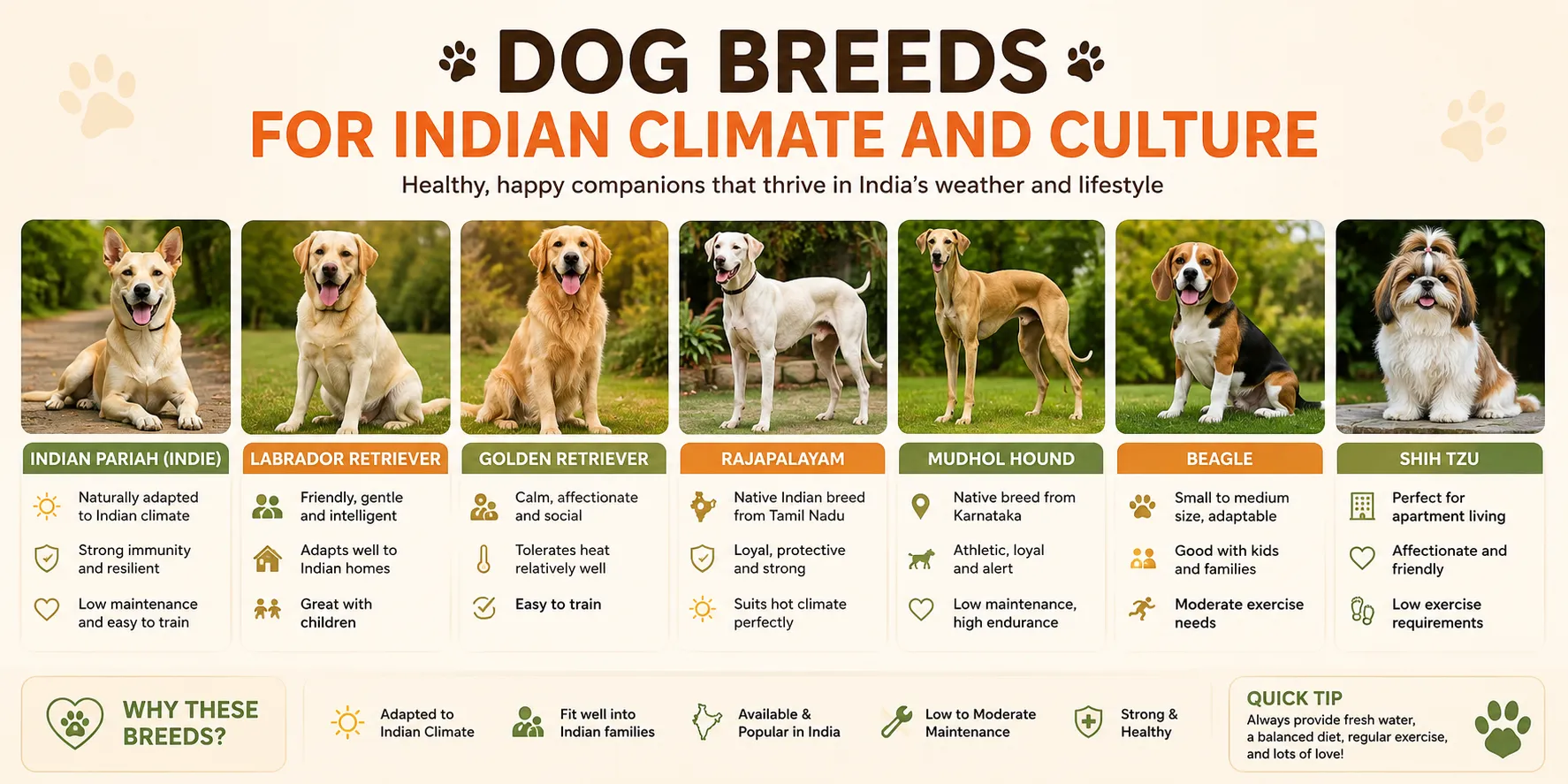
Table of contents
- The short answer, if you only read one section
- India’s Diverse Weather Regions
- How dogs actually cool down, and why coat and muzzle decide everything
- Breeds that genuinely thrive in Indian conditions
- Breeds that struggle here, said plainly
- For the hills: the breeds India forgot
- The culture half: what nobody tells you before you bring a dog home
- Feeding a dog for Indian conditions
- The monsoon chapter: ticks are the real threat, not the rain
- Five questions to answer honestly before you choose
- The bottom line
- FAQs
Most breed lists you will find for India are written backwards. They start with a popular breed and then explain why it “adapts well.” The better question, and the one every experienced Indian pet parent eventually asks, is simpler:
Does this dog fit my weather, my home, and my honest daily routine?
Get that right, and almost everything else becomes easier. Get it wrong, and you spend the next twelve years managing problems that were baked in on day one.
This guide is built around that question. It covers which breeds genuinely do well here, which ones struggle and why, what Indian law actually says about your right to keep a dog, and how our climate quietly changes what should go in your dog’s bowl.
The short answer, if you only read one section
The breeds that handle Indian conditions best are short-coated, lean-framed, long-nosed dogs that evolved here or in similar climates: the Indian Pariah (Indie), Rajapalayam, Mudhol Hound, Chippiparai, Kombai, Rampur Greyhound, and Indian Spitz. Among foreign breeds, the Labrador, Beagle, Dobermann, Dachshund, and Whippet manage well with sensible care.
The breeds that struggle most are thick double-coated dogs built for cold (Siberian Husky, Alaskan Malamute, Saint Bernard, Tibetan Mastiff, Chow Chow) and flat-faced dogs that cannot pant efficiently (Pug, French Bulldog, English Bulldog, Shih Tzu).
Now the detail that actually helps you decide.
India’s Diverse Weather Regions
This is where most breed advice falls apart. Advice written for Chennai is close to useless in Shimla.
Broadly, you are living in one of these:
Hot and humid coastal (Mumbai, Chennai, Kochi, Kolkata, Goa): The hardest zone for dogs. Humidity blocks evaporative cooling, so panting works less well exactly when the dog needs it most.
Hot and dry (Rajasthan, parts of Gujarat, Vidarbha, interior Deccan): Brutal daytime highs but real relief at night, and low humidity means panting still works.
Composite north (Delhi NCR, Punjab, UP, Bihar): Extreme swings. Genuinely hot summers and genuinely cold winters. Dogs need year-round adaptability.
Tropical wet monsoon belt (Konkan, Western Ghats, Northeast): Months of damp. Skin and ear problems dominate, not heat.
Temperate hills (Shimla, Ooty, Darjeeling, Kodaikanal): The one zone where thick-coated breeds actually belong.
Cold mountain (Ladakh, Spiti, high Himachal, Uttarakhand, Sikkim): Native mountain breeds thrive. Short-coated hounds suffer.
Why humidity is the hidden villain: a study found wet-bulb temperatures have been rising along India’s coasts for decades. Wet-bulb temperature combines heat and humidity, and it is the number that predicts whether evaporative cooling works at all. A 33°C day in Mumbai can stress a dog more than a 40°C day in Jodhpur.
How dogs actually cool down, and why coat and muzzle decide everything
Dogs do not sweat across their skin the way we do. They shed heat mainly by panting, which relies on evaporation from the moist surfaces of the mouth, tongue and upper airway, plus a little through the paw pads.
Two things determine how well that works:
Muzzle length: A long nose is a large evaporative surface. A flat face is a small one, often with narrowed nostrils and a crowded airway.
Coat structure: A single short coat lets heat out. A dense double coat is insulation, and insulation works in both directions.
High-Risk Breeds: Breeds like Chow Chows (17x), Bulldogs (14x), and Pugs (3x) have significantly higher heat illness odds.
Size Factors: Dogs over 50kg face 3.5x higher risk; overweight dogs face 1.5x higher risk.
Indian Context: Flat-faced dogs overheat at 21°C–22°C (a cool Indian morning), meaning AC and managed walk times are mandatory.
Breeds that genuinely thrive in Indian conditions
Indian Pariah Dog (Indie or Desi dog)
If there were one honest recommendation in this entire guide, this is it. The Indie is not a “budget option.” It is a landrace shaped by thousands of years of natural selection in exactly the conditions you live in.
Short single coat, lean frame, efficient panting, strong general immunity, and a low incidence of the inherited structural problems that plague heavily line-bred pedigrees. They are alert, quick to learn, deeply loyal once bonded, and famously low-maintenance on grooming.
Dogs have been part of this subcontinent for a very long time. Remains closely related to greyhound types have been found at Mature Harappan sites, and Pariah-type and mastiff-type dog figurines are among the most common recovered.
Best for: Every zone. First-time owners. Apartments and independent houses alike.
Watch for: They are intelligent and get bored. They need mental work, not just walks. Early socialisation matters if adopted older.
Rajapalayam
A tall, elegant white sighthound from Tamil Nadu with a short coat and a genuinely regal presence. Built for heat, historically used for hunting and guarding.
Best for: Hot and dry, hot and humid, homes with space.
Watch for: Reserved with strangers and needs real exercise. Not an apartment dog for a sedentary household. White coats and pink skin around the nose and eyes can be sun-sensitive.
Mudhol Hound (Caravan Hound)
Native to the Karnataka and Maharashtra border region, lean and fast with excellent stamina and sight. This is the breed that has genuinely broken through institutionally: Mudhol Hounds have been inducted into the Indian Army, CISF and NSG dog squads, and Kombai dogs into the CRPF.
Best for: Deccan, hot and dry, active owners with space.
Watch for: High prey drive. Needs secure, off-lead running space, and that is genuinely hard to find in cities.
Chippiparai
Another South Indian sighthound. Slim, athletic, built for endurance in heat, and known for bonding intensely with one person.
Best for: Hot and dry, hot and humid, experienced owners.
Watch for: Very low body fat means they feel cold quickly in northern Indian winters. Sensitive and does not do well with harsh handling.
Kombai (Combai)
A powerful, muscular guardian breed with a short coat and real toughness. Sometimes called the Indian bear hound.
Best for: Homes needing a working guardian, hot climates, owners with dog experience.
Watch for: This is not a beginner’s dog. Strong protective instincts need confident, consistent, early training.
Rampur Greyhound
From Uttar Pradesh, tall and short-coated, historically bred for hunting. Handles heat well and is calmer indoors than its athleticism suggests.
Best for: North India composite climate.
Watch for: Needs sprint opportunities. Thin skin injures easily.
Indian Spitz
Often confused with a Pomeranian, but a different dog. Adapted over decades in India, with a coat that is softer and less dense than true cold-climate spitzes. Genuinely apartment-friendly.
Best for: Apartments across most zones, families with children, first-time owners.
Watch for: Still needs seasonal trimming and regular brushing. Can be vocal, which matters in a shared building.
Labrador Retriever
India’s most popular dog for good reason: friendly, trainable, tolerant of children and chaos. The short dense coat handles heat reasonably, though not effortlessly.
Best for: Families, most zones with sensible summer routines.
Watch for: Weight. This is the single biggest Labrador issue in India, and it is not cosmetic. Being heavy for their breed raised heat-illness odds by around 1.5 times in the Hall study. Labradors are also prone to hip and elbow dysplasia, and every extra kilo makes that worse.
Beagle
Compact, short-coated, cheerful and genuinely suited to apartments.
Best for: Apartments, families, most warm zones.
Watch for: Those long drop ears trap moisture and are a common site of infection in humid and monsoon conditions. Weekly ear checks are non-negotiable. Also strongly food-motivated and prone to obesity.
Dobermann Pinscher
Short sleek coat, lean muscular build, excellent heat tolerance and high intelligence.
Best for: Hot climates, active owners, homes wanting a guardian.
Watch for: Needs serious training and socialisation. Note that Dobermanns appeared on the 2024 central advisory list discussed below, which affects housing society politics even though it is not enforceable law. Also worth knowing that German Shepherds and Dobermanns are frequently flagged as susceptible to the effects of ehrlichiosis.
Dachshund
Small, short-coated, bold, and adaptable to apartment life.
Best for: Apartments, smaller homes, most zones.
Watch for: Their long backs make them prone to intervertebral disc disease. Discourage stair-climbing and jumping off furniture, and keep them lean.
Whippet
Bred in the UK but genuinely well-suited here. Lean frame, minimal coat, low body fat, gentle temperament, and surprisingly calm indoors.
Best for: Apartments with access to a safe running area.
Watch for: Very little insulation. Needs a coat in north Indian winters. Thin skin tears easily. Note that Greyhound types appeared in the higher heat-illness odds group in the Hall study, largely because of exertional heat stress, so control the intensity of exercise rather than the exposure.
Breeds that struggle here, said plainly
This is not written to shame anyone. Many wonderful dogs in India belong to these breeds and are loved well. If you already have one, the section after this is for you. If you are still deciding, please read it twice.
Siberian Husky and Alaskan Malamute: Dense double coats engineered for Arctic conditions. Worryingly, the Husky has been reported as a fast-rising favourite among Indian owners. In most of India, they need year-round climate control to be comfortable, not just during May.
Saint Bernard: Large, heavy-coated, and heavy-bodied. Remember that dogs over 50kg had almost three and a half times the heat-illness odds in the Hall study.
Tibetan Mastiff: Belongs in the high Himalaya, where it originated. It is genuinely at home in Ladakh, Spiti, and high Himachal, and genuinely suffering in Hyderabad.
Chow Chow: The worst combination available: an extremely dense coat plus a compact face. Highest odds of any breed in the Hall study at roughly 17 times the Labrador baseline.
Pug, French Bulldog, English Bulldog, Shih Tzu: Flat-faced breeds carry brachycephalic obstructive airway syndrome risk. Research using objective respiratory function testing found roughly 50% of studied dogs in three extreme brachycephalic breeds were affected, and an estimated 60% of owners do not recognise the clinical signs. That last number is the one that should worry you. Loud snoring is not “cute”; it is a clinical sign.
Golden Retriever: A genuine surprise to many Indian owners. The Hall study placed Goldens at roughly three times the Labrador baseline for heat-related illness, driven by the dense feathered double coat.
If you already have one of these dogs
You have not made an unfixable mistake. You have signed up for a more demanding job. Walk only after dark and before sunrise. Test the pavement with the back of your hand for seven seconds; if you cannot hold it, neither can their paws. Keep them in the coolest room of the house during peak hours. Never shave a double coat down to the skin, because that coat also blocks solar radiation and shaving can worsen things; brush out the dead undercoat instead. Keep weight strictly in check, because it is the one major risk factor you fully control. And learn the emergency signs: frantic panting, drooling, brick-red gums, wobbliness, vomiting, or collapse. That is a same-hour emergency, not a wait-and-see.
For the hills: the breeds India forgot
If you live in Shimla, Manali, Leh, Gangtok or the Nilgiris, the advice inverts completely.
The Gaddi (Himachali Hound) is a mastiff-like Himalayan livestock guardian with a thick protective coat, less bulky than a Tibetan Mastiff. The Bhotia and Himalayan Sheepdog fill similar roles across the mountain belt. These are the dogs that belong in cold India, and they are quietly disappearing as mountain livelihoods change.
Fact: Native breeds like Mudhol Hound and Rajapalayam were highlighted by PM Modi in 2020 for lower costs and superior climate adaptation.
The culture half: what nobody tells you before you bring a dog home
Climate decides whether your dog is comfortable. Culture decides whether your life with that dog is workable. This section matters as much as the breed list.
Your housing society cannot ban your dog. Know this before the notice arrives.
This is the single most common conflict Indian pet parents face, and most people fold because they do not know the law.
Under Animal Welfare Board of India guidelines, RWAs and apartment owners’ associations cannot ban pets, and cannot do so even by amending bye-laws or by a unanimous resident vote. They cannot restrict dogs by breed or by size. They cannot bar pets from lifts, corridors or common areas. They cannot levy special “pet fees” or fines. Barking alone is not valid grounds for action.
What societies can reasonably require: that your dog is leashed in common areas, that you clean up after them, that vaccination records and municipal registration are current, and that you observe agreed walking hours formalised in a general body meeting.
Practical advice: be the pet parent nobody can complain about. Leash, scoop, train, and keep your paperwork in a folder. Most disputes die there.
Is there a dog breed ban in India? No, and here is exactly why
You will hear this repeated confidently and wrongly.
On 12 March 2024, the Department of Animal Husbandry and Dairying issued a circular asking states and union territories to prohibit the import, breeding and sale of 23 breeds described as ferocious, including the Pit Bull Terrier, Rottweiler, American Bulldog, various Mastiffs, Cane Corso, Boerboel, Dogo Argentino, Tosa Inu and several Shepherd and Ovcharka types, plus their crosses.
The Karnataka High Court quashed it on 10 April 2024, citing the lack of stakeholder consultation. The Delhi High Court also set it aside after the Centre deferred implementation and agreed to invite public objections. Several other High Courts had stayed it as well.
What this means for you: there is no enforceable nationwide breed ban, and an existing pet cannot be taken from you. But some cities have written their own local restrictions in the gap, and society-level politics around these breeds remains real regardless of what the law says. If you are considering a listed breed, check your municipal rules and be prepared for social friction. Laws change, so verify the current position before you commit.
Joint families, small children and elders
Indian homes are often fuller than Western ones, with a steady flow of relatives, domestic help, delivery agents and neighbours. This has two implications.
A guardian breed with strong territorial instincts (Kombai, Rajapalayam, Dobermann) needs far more socialisation here than the same dog would need in a quiet two-person household. Every new face is an event.
Conversely, a dog that is never alone is a gift. Breeds prone to separation anxiety do beautifully in joint families if your household has someone home most of the day; that widens your options considerably.
For homes with toddlers or elderly family members, favour predictable temperaments and manageable size: Indie, Indian Spitz, Beagle, Labrador, Dachshund.
The vegetarian household question
This comes up constantly on Indian forums and deserves a direct answer. Dogs are omnivores with a strong requirement for high-quality, digestible animal-source protein. Up to 35% of a dog’s daily protein intake goes to maintaining skin and coat alone.
If your kitchen is vegetarian and you are not comfortable cooking meat at home, a complete and balanced commercial dog food is not a compromise. It is the cleanest solution available, because it keeps the meat handling entirely out of your kitchen while meeting the dog’s needs properly. Many Indian families run exactly this arrangement without friction.
Also, please do not feed your dog the family’s roti and dal as a main diet. It is well-intentioned, and it is nutritionally incomplete, typically short on animal protein, essential fatty acids, and several micronutrients, and often far too high in salt and spice.
The heritage most breed lists skip
There is a long and genuinely beautiful thread of dogs in Indian culture, and it is worth knowing when someone tells you dogs are somehow un-Indian.
Bhairava, a fierce form of Shiva, has a dog as his vahana, unusual among deities who ride lions, bulls and eagles. At the Kilkari Bhairava temple in Delhi, there is no image of Shiva’s bull at all, only dogs, and the courtyard holds real ones, fed and petted by devotees. In Varanasi, the city of Kala Bhairava, feeding street dogs before visiting the temple is an established devotional act. Khandoba, worshipped across Maharashtra, Karnataka, and Telangana, rides into battle with a dog beside him. (Sources: Dog With Blog on dogs in Hinduism; Depth Dog Guide)
And the Mahabharata saves the best for last. Climbing toward heaven, Yudhishthira alone remains, walking with a stray that has followed him the entire way. Offered entry without the dog, he refuses. The dog reveals himself as Dharma. The lesson is not subtle: how you treat the creature that depends on you is the measure of you.
Kukur Tihar, observed on the second day of Tihar in Nepal and in parts of Sikkim, Darjeeling and West Bengal, gives dogs a tika, a marigold garland and a plate of food, pets and street dogs alike.
The Indie adoption shift
The most encouraging development in Indian pet ownership is that adopting an Indie has stopped being a consolation prize. Rescue organisations, celebrities and social media have shifted the narrative substantially, and shelters in cities like Pune, Bengaluru and Mumbai report growing adoption rates.
Feeding a dog for Indian conditions
Here is the part that most breed guides leave out entirely, and it is where a lot of everyday comfort is either won or lost. Indian conditions place four specific demands on nutrition.
1. Hydration is a food problem, not just a water-bowl problem
Kibble typically contains around 10% moisture. Wet food contains far more, and serving wet food or adding moisture to meals is one of the most effective ways to raise total daily water intake, especially in dogs that are poor drinkers. (Source: Marleybones)
Practically, this is why so many experienced Indian owners switch to a mixed feeding routine from March through June. A gravy-based meal like Chicken Platter in Gravy for adults or With Lamb in Gravy delivers meaningful moisture along with the meal itself, which is useful when summer appetite dips and your dog is eating less overall. For puppies going through the same seasonal appetite drop, Chicken and Liver Platter in Gravy for puppies does the same job at the right nutrient density for growth.
Also worth knowing: heat suppresses appetite, so dogs often prefer to eat in the cool of early morning and late evening. Shift meal times rather than fighting them.
2. Skin and coat take a beating in humidity
Humid coastal air and months of monsoon damp make skin the most common complaint Indian vets hear. Omega-3 fatty acids are consistently linked to skin and coat health and to reduce inflammation, and protein quality matters because hair is largely protein.
This is one reason it is worth actually reading the ingredient panel rather than the front of the pack. Look for formulas with salmon oil and linseed as quality omega-3 sources, paired with digestible chicken proteins, alongside turmeric and rosemary for antioxidant support.
3. Joints, especially for large breeds and heat-restricted dogs
Labradors, German Shepherds, Rottweilers and Golden Retrievers carry real orthopaedic risk in India, worsened by the weight gain that follows when summer walks get shortened. Glucosamine, chondroitin sulphate and omega-3 fatty acids are the ingredients most consistently associated with joint support.
Bowlers Nutrimax Adult provides balanced nutrition with protein, vitamins, minerals and fibre, making it a practical option for adult dogs during periods when activity levels may be lower.
4. Gut, and the apartment problem nobody mentions politely
Heat and humidity are hard on digestion, and diet changes during summer often trigger loose stools. Prebiotic fibre sources such as beet pulp and chicory pulp support gut function.
Getting life stage right
Puppies need different calorie density, calcium-to-phosphorus balance, and DHA than adults do, and large-breed puppies particularly need controlled growth to protect developing joints. Feed a genuine puppy formula such as Bowlers Nutrimax Puppy rather than simply giving smaller portions of adult food, and transition to an adult diet on your vet’s timeline for that breed’s size.
For training, and specifically for the leash manners that keep your RWA relationship healthy, keep reward-sized treats on hand. Bowlers Jerky works well for this, though the general rule holds regardless of brand: treats should stay under roughly 10% of daily calories.
You can browse the full range on the Bowlers products page, and there is a broader reference guide on choosing dog food in India if you want to compare types. If you prefer buying in person, their store locator will find a stockist near you.
One important caveat: switch foods gradually over seven to ten days, mixing increasing proportions of the new food into the old. Abrupt changes cause digestive upset, and in an Indian summer that is the last thing a dehydrated dog needs.
The monsoon chapter: ticks are the real threat, not the rain
Summer gets all the attention. The monsoon quietly causes more illness.
Warm, humid conditions are ideal breeding weather for the brown dog tick (Rhipicephalus sanguineus), which carries the two most common tick-borne diseases in Indian dogs: ehrlichiosis (Ehrlichia canis, a bacterium that attacks white blood cells) and babesiosis (a protozoan parasite that destroys red blood cells and causes anaemia). Both are endemic in India, and both can be fatal if missed, though they are usually treatable when caught early.
What to do: daily tick checks during warm and wet months, running your hands over the whole dog with attention to ears, between toes, the neck, and under the collar. Remove ticks with a pair of tweezers close to the skin. Symptoms usually appear one to three weeks after an infected tick attaches, and the early signs are vague: lethargy, loss of appetite, fever. Pale gums, dark urine, pinpoint red spots on the skin, or any bleeding that will not stop mean you should go to the vet the same day.
Also discuss leptospirosis vaccination with your vet if you live somewhere that floods, since it spreads through water contaminated with infected animal urine and is transmissible to humans.
Five questions to answer honestly before you choose
- Which of the six climate zones do you actually live in? Not where you grew up. Where the dog will live.
- How many hours will this dog be alone on a normal Tuesday? Be honest, not aspirational.
- Do you have reliable access to a safe area for real exercise? A sighthound without running space is a frustrated dog.
- What is your genuine monthly budget? Food, vaccinations, deworming, tick prevention, grooming, boarding when you travel, and an emergency fund. Access to affordable veterinary care is itself a reported difficulty for a meaningful share of Indian pet parents.
- Who takes this dog when you get transferred to another city? The answer should be “me, obviously.” If it is not, wait.
One more thing worth sitting with. Around half of pet owners in India reported having relinquished a pet since the start of the pandemic, against a global figure closer to 28%. Those are dogs who were chosen carelessly and then became inconvenient. Choosing well is the first act of care, and it happens before the dog ever comes home.
The bottom line
The best dog for India is not the one that photographs well in a winter coat. It is the one that can breathe comfortably in May, stay healthy through the monsoon, live peacefully in the home you actually have, and be cared for properly on the budget and schedule you actually keep.
More often than not, that dog is already waiting in a shelter near you, or sleeping under a car on your own street. India spent thousands of years perfecting a dog for exactly these conditions. It seems a shame not to use it.
Whatever you choose, feed it well for the climate it lives in. Explore the full Bowlers range to find the right fit for your dog’s size, age and season.
FAQs
Which dog breed is best for the Indian climate?
Native breeds like the Indian Pariah (Indie), Rajapalayam, and Mudhol Hound are best adapted to India’s climate, though breeds like Labradors and Beagles also adapt well with basic summer care.
Can a Siberian Husky survive in India?
. Huskies can survive in India, but their dense Arctic coats require year-round air conditioning and strict summer care to keep them safe.
Are Indie dogs better than pedigree dogs in India?
Indies are usually better suited for Indian homes because they are naturally climate-adapted, healthier, lower maintenance, and more cost-effective than pedigree breeds.
Is there a dog breed ban in India in 2026?
There is no active nationwide ban, as the 2024 circular prohibiting 23 breeds was quashed by High Courts due to a lack of stakeholder consultation.
Can your housing society or RWA ban your dog?
No, Animal Welfare Board guidelines prohibit RWAs from banning pets, restricting breeds, or blocking dogs from lifts and common areas.
What should you feed your dog during an Indian summer?
Prioritize hydrations and skin/joint support by feeding wet food during cooler hours and offering omega-3s, glucosamine, and chondroitin.
Which dog breeds are most at risk of heat stroke?
Flat-faced breeds (Chow Chows, Bulldogs, Pugs) and dogs weighing over 50kg face up to 17 times higher odds of heat-related illness.
Sources referenced: India Meteorological Department; Hall et al., Scientific Reports, 2020 (VetCompass, Royal Veterinary College and Nottingham Trent University); Beard et al., Veterinary Record, 2024; Liu et al., PLOS ONE; Animal Welfare Board of India circular, 20 February 2014; Karnataka High Court and Delhi High Court judgments, April 2024; Statista; VCA Animal Hospitals; Hill’s Pet; National Geographic; Deccan Herald; ThePrint; LiveLaw; SCC Online; Newsonair, Ministry of Information and Broadcasting; PubMed and NCBI research archives.
*This guide is for general information and is not a substitute for veterinary advice. Please consult your veterinarian for guidance specific to your dog, particularly on diet changes, vaccination schedules, and any signs of illness.